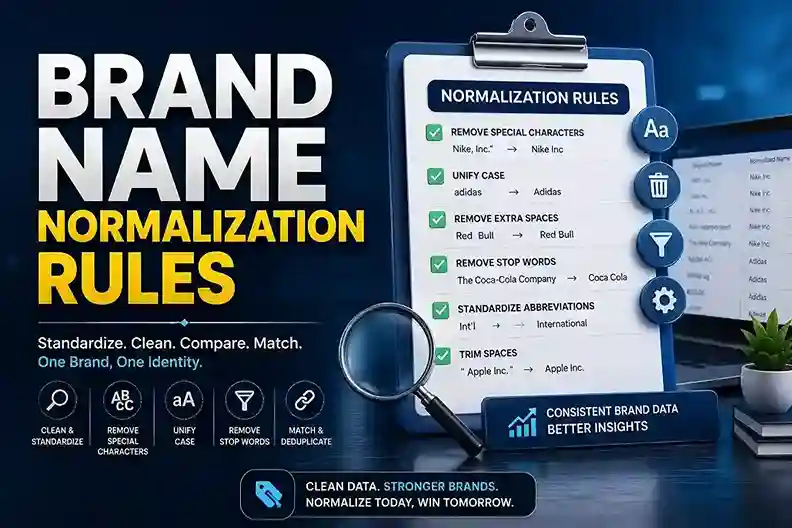
Your CRM lists three versions of the same company: “Apple Inc.,” “apple,” and “APPLE.” Each entry fractures your sales reporting, distorts customer insights, and hides a top client’s real value. That chaos happens because nobody applied clear brand name normalization rules. When every system speaks a different brand language, your data lies. This guide hands you a battle-tested framework to standardize brand names, wipe out duplicates, and finally trust your numbers.
What Are Brand Name Normalization Rules?
Brand name normalization rules transform inconsistent brand references into a single, authoritative format. You strip extra spaces, fix letter cases, expand abbreviations, remove noise words, and map every variation to one canonical name. Instead of “Coca-Cola,” “Coca Cola,” and “COCA COLA,” you get one agreed-upon record. These rules turn chaotic free-text fields into reliable identifiers that analytics, marketing, and sales systems can use without errors. Without them, you own a data landfill. With them, you build a clean foundation for any report or campaign.
The process borrows from data normalization practices used in database design and text mining, but it focuses specifically on brand entity resolution. You are not just cleaning strings; you are preserving brand identity so machines and humans recognize the same organization every time.
Why Messy Brand Names Cost More Than You Think
Fragmented brand data drains money in three hard ways.
- Skewed analytics: A single advertiser appears as three separate spenders, so your ROI calculations flatter or punish the wrong brand.
- Wasted operational hours: Teams manually deduplicate records in Excel, often repeating the work every quarter.
- Broken customer experiences: An email that addresses “IBM Corp.” when the user knows the brand as simply “IBM” feels robotic and impersonal.
A 2023 study on data quality in enterprise systems by Rahm and Do showed that dirty data typically accounts for 15–25% of operating expenses in information-intensive companies. Brand name inconsistencies form a large chunk of that waste. Normalization closes the leak fast.
Core Brand Name Normalization Rules That Fix 90% of Chaos
Apply these rules in sequence. Each handles a specific layer of mess.
1. Strip Leading, Trailing, and Redundant Whitespace
Spaces hide at the beginning and end of text fields. Double spaces sneak between words. Start by trimming all outer spaces and collapsing multiple inner spaces into one.
Example: “ Microsoft Corporation ” becomes “Microsoft Corporation”.
2. Unify Letter Case
Convert all text to title case, uppercase, or lowercase depending on your master style guide. Title case works well for display, but lowercase often simplifies matching. Choose one and stick to it across all systems.
Example: “SAMSUNG ELECTRONICS” → “Samsung Electronics” (title case) or “samsung electronics” (lowercase for machine matching).
3. Remove Legal Entity Suffixes When They Do Not Distinguish Brands
Suffixes like Inc., Corp., Ltd., LLC, GmbH usually add zero identification value inside your own database. Strip them unless two distinct legal entities share the same trading name and you must separate them.
Example: “Nike, Inc.” → “Nike”. If you have “Nike Inc.” and “Nike LLC” and they represent the same parent, collapse to “Nike”. Keep only if the distinction is important for compliance or contracts.
4. Expand or Contract Standard Abbreviations
Create a mapping table for known abbreviations. “Intl” becomes “International”, “Tech” stays unless your rule says “Technology”. Apply the mapping consistently so every record uses the full form or the same short form.
Example: “Amazon Web Svcs” → “Amazon Web Services”.
5. Normalize Punctuation and Special Characters
Strip periods from acronyms, remove apostrophes that do not change meaning, and replace en dashes with hyphens. Unify ampersands.
Example: “AT&T” stays, but “A.T.&T.” becomes “AT&T”. “Johnson & Johnson” and “Johnson and Johnson” should become one variant.
6. Handle “The” and Other Noise Words
A leading “The” often disappears in casual references. Decide whether your canonical name keeps it. If you drop it, “The Home Depot” becomes “Home Depot”. Map both entries to the same final value. The rule must be explicit so a search for “The Body Shop” still finds the normalized “Body Shop”.
7. Standardize Spacing in Compound Brand Names
Some brands intentionally combine words (“Facebook”, not “Face book”), others use hyphens (“Coca-Cola”). Your rule must respect the brand’s official styling while handling common typos. Store a “display name” that matches brand guidelines and a “match key” stripped of all formatting for deduplication.
8. Resolve Common Misspellings and Phonetic Errors
Build a fuzzy matching layer. Soundex, Metaphone, or Levenshtein distance algorithms catch “Dell” spelled as “Del” or “Dl”. Flag near-matches for human review, but automate high-confidence merges.
Example: “Pepsi” and “PepsiCo” are separate brands; “Pepsi” vs “Pepsi” with a trailing space is the same. Never blindly merge.
9. Map Acquisitions and Rebrands
When one company buys another and retires the acquired brand, your normalization rules must fold the old name into the current one. “Mandiant” now operates under “Google Cloud” for some services. Maintain a relationship table so historical data links correctly. This step demands ongoing maintenance.
10. Preserve the Brand’s Preferred Styling in Display Fields
Normalization does not mean erasing identity. Always keep a “display_name” column that matches the brand’s own writing style—capitalization, punctuation, and spacing exactly as the brand uses publicly. The machine-readable match key remains separate.
Example: Match key: “apple”, display name: “Apple”.
A Step-by-Step Process to Implement Brand Name Normalization Rules
Turn the rules into an operational workflow your team can run without a data science degree.
- Audit your raw data. Export brand name columns from CRM, marketing platform, billing system. Count unique values.
- Profile the mess. Group by frequency. Spot the top 50 variants of your largest accounts. Manually label the canonical name for each cluster.
- Build a transformation recipe. Using the rules above, create a sequence of cleaning steps. OpenRefine, Python pandas, or a dedicated ETL tool works.
- Generate the match key. Apply lowercase, remove punctuation, strip suffixes, replace abbreviations, collapse spaces. This becomes the deduplication key.
- Cluster with fuzzy logic. Set a similarity threshold (0.85 on a 0–1 scale is often safe). Merge records whose match keys score above that.
- Human review the boundary cases. Let a data steward approve or reject merges where confidence is medium.
- Store the mapping. Keep a lookup table with every raw input and its normalized brand ID. Never lose the lineage.
- Automate new incoming data. Push every new brand entry through the same pipeline before it lands in your reporting database.
Brand Name Normalization Rules Table: Before and After
This table shows raw values and the result after applying a consistent set of normalization rules (lowercase match key, trimmed, suffix-stripped, standard abbreviation, no extra punctuation).
| Raw Input | Normalized Match Key | Display Name |
|---|---|---|
| IBM Corp. | ibm | IBM |
| International Business Machines | ibm | IBM |
| Coca-Cola Enterprises Inc. | coca cola enterprises | Coca-Cola Enterprises |
| COCA COLA | coca cola | Coca-Cola |
| The Procter & Gamble Company | procter gamble | Procter & Gamble |
| P&G | procter gamble | Procter & Gamble |
| Amazon Web Services, LLC | amazon web services | Amazon Web Services |
| AWS | amazon web services | Amazon Web Services |
| Alphabet Inc. | alphabet | Alphabet |
| Google LLC |
The match key eliminates everything that prevents accurate grouping. The display name honours the brand’s public identity. Both live in your master brand table.
Tools That Make Brand Name Normalization Practical
You do not need to build algorithms from scratch. Several mature tools handle text normalization and entity resolution.
- OpenRefine (free): Provides clustering, GREL expressions, and faceting to clean and normalize brand columns interactively. Its clustering feature groups “Coca Cola” and “Coca-Cola” with adjustable keying functions. OpenRefine documentation explains key collision methods.
- Python with Pandas and fuzzywuzzy: Write a script that chains string operations and applies fuzzy matching at scale. Best for teams with engineering support.
- Talend Data Quality: Offers prebuilt components for standardization, matching, and survivorship rules. Suitable for enterprise ETL pipelines.
- Salesforce Duplicate Management: If your CRM is the source of truth, use matching rules and duplicate alerts to enforce brand normalization at the point of entry.
How to Handle Multilingual and Global Brand Names
Brands often use different scripts or local variations. Normalization rules must respect these without creating false duplicates.
- Transliterate non-Latin scripts: Convert “トヨタ” to “Toyota” using ICU transforms or a curated mapping. Keep the original script in a separate column for local campaigns.
- Manage regional naming: “Nestlé España” and “Nestlé” describe the same global parent. Normalize to the global parent brand while preserving the regional entity tag for operational use.
- Watch for false friends: “Orange” in France is a telecom, while “Orange” in California may refer to a construction company. Add a country or domain attribute to separate homographic brands.
Common Mistakes That Undo Your Normalization Effort
Even careful teams slip. Avoid these pitfalls.
- Over-normalizing: Stripping too much detail can merge genuinely different brands. A university “U of T” and a healthcare chain “U of T Health” should not become the same record.
- Ignoring maintenance: Mergers, rebrands, and new spelling variants appear monthly. Set a quarterly review cycle.
- Forcing a single match key without a display name: Your finance system may need “Google LLC” for legal invoices, while your dashboard shows “Google”. Always carry both fields.
- Applying rules inconsistently across sources: If your web form strips “Inc.” but your sales team manually enters it, the pipeline must handle both without breaking.
Where Brand Name Normalization Rules Fit in Your Data Stack
These rules sit at the ingestion layer, right after raw data lands. They feed clean brand dimensions into your data warehouse, BI tool, and customer data platform. Marketing attribution, customer lifetime value, and vendor spend analysis all rely on correctly grouped brands. Without normalization, your Looker or Power BI dashboard will paint a fragmented picture that decision-makers cannot trust.
Sales teams also benefit immediately. A rep viewing an account history that merges all spellings of “Salesforce” sees the full relationship. They stop asking “Is this a new lead?” when the account already exists under a typo. The result: faster deals and fewer embarrassing duplicate outreaches.
How to Sell Brand Name Normalization to Your Leadership
Leaders care about cost, speed, and trust. Frame the initiative like this: “We currently spend X hours per month manually merging reports because brand names don’t match. Implementing normalization rules eliminates that work and gives us accurate marketing ROI within 90 days.” Attach a small pilot. Show the before-and-after on top-spending accounts. The difference in clarity usually wins the budget.
Frequently Asked Questions About Brand Name Normalization Rules
In layman’s words, what are brand name normalization rules?
They are a set of text cleaning and matching steps that turn messy brand spellings into one consistent name for every company in your database. Think of them as a translator that makes all systems speak the same brand language.
How do brand name normalization rules improve marketing reports?
When every campaign platform and CRM uses the same canonical brand name, attribution data stops fragmenting. You see the true cost per lead and revenue per brand instead of split numbers that hide performance.
Can normalization rules handle typos and phonetic errors automatically?
Yes. Fuzzy string matching algorithms like Levenshtein distance or token-based comparisons can catch “Dell” typed as “Del” and suggest a merge. High-confidence matches are automated; borderline cases require a human review step.
Should brand normalization remove legal suffixes like Inc. or LLC?
Usually, yes. For internal analysis, suffixes add noise. Keep them only if you have separate legal entities with identical trading names and a compliance reason to distinguish them. Always store the full legal name in a backup field.
How often should we update our brand name normalization rules?
Review rules quarterly. Brands rebrand, acquire, or change spelling conventions. New variants slip in through manual entries and third-party data feeds. A quarterly refresh catches drift before reports suffer.
What is the difference between normalization and deduplication?
Normalization transforms brand text into a consistent format. Deduplication uses that normalized output to find and merge records that refer to the same entity. Normalization prepares the data; deduplication acts on it.
Start Cleaning Your Brand Data in the Next Hour
You already have the raw material: an export of brand names from one system. Take the top 50 most frequent values and apply the rules from this guide manually in a spreadsheet. You will see duplicates collapse and true customer concentration jump out. Once that quick win proves the value, pick a tool and automate the flow. Small, consistent normalizations compound into six-figure savings and decision-quality insights. Open your data, pick the messiest brand, and normalize it now.