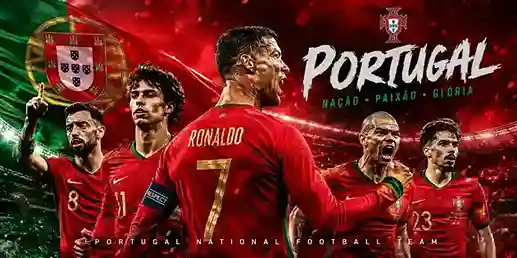
You hear the name and immediately picture crimson red shirts, a captain’s armband on Cristiano Ronaldo, and a nation of 10 million that refuses to back down. The Portugal national football team is not just another European squad. It is a story of transformation, heartbreak, and finally, glory.
This guide walks you through everything that makes A Seleção tick. You will learn about the golden eras, the tactical evolution, the legendary players, and the records that define this footballing nation.
The Origins and Early Struggles
The Portuguese Football Federation formed in 1914. The national team played its first official match in 1921 against Spain, losing 3-1. For decades, Portugal remained a footnote in European football.
The domestic league produced quality players, but the national setup lacked structure. Qualification for major tournaments proved elusive. Between 1930 and 1962, Portugal failed to reach a single World Cup or European Championship.
Everything changed in the mid-1960s. A player emerged from Mozambique, then a Portuguese colony, who would alter the course of football history forever. His name was Eusébio.
The Eusébio Era That Put Portugal on the Map
Eusébio da Silva Ferreira arrived on the global stage at the 1966 World Cup in England. What he did there made the Portugal national football team impossible to ignore.
Portugal reached the semifinals in their first-ever World Cup appearance. Eusébio scored nine goals in the tournament, winning the Golden Boot. His four-goal performance against North Korea in the quarterfinals remains one of the greatest individual displays in World Cup history. Portugal trailed 3-0 after 25 minutes. Eusébio scored four times in 32 minutes. Portugal won 5-3.
Benfica’s star striker finished his international career with 41 goals in 64 appearances. For 30 years after his retirement, Portugal searched for someone to fill that void. The search took longer than anyone expected.
The Golden Generation Ronaldo Built
Cristiano Ronaldo debuted for the Portugal national football team in 2003 as an 18-year-old with lightning pace and tricks that frustrated defenders. Nobody predicted what would follow.
Ronaldo transformed A Seleção from tournament outsiders into permanent contenders. His leadership coincided with Portugal’s most consistent period of success. Between 2004 and 2022, Portugal qualified for every major tournament.
The heartbreak of losing the Euro 2004 final on home soil to Greece shaped Ronaldo’s obsession with delivering a trophy. He achieved it 12 years later, then added another. His 130+ international goals make him the highest-scoring men’s international footballer in history.
But Ronaldo did not build this alone. Luís Figo, Rui Costa, Deco, and later Pepe formed the supporting cast that carried Portuguese football through different eras.
Fernando Santos and the Euro 2016 Miracle
Portugal entered Euro 2016 as outsiders. They finished third in their group behind Hungary and Iceland. Nobody considered them favorites, especially after Ronaldo described their style as “parking the bus” before it became a compliment.
Fernando Santos built a defensive fortress. Portugal conceded only five goals in seven matches. The final against host nation France in Paris tested every ounce of resilience. Ronaldo left the pitch in tears after a knee injury in the 25th minute.
Éder, a substitute striker few considered world-class, scored the winning goal in extra time. The 1-0 victory delivered Portugal’s first major international trophy. Santos had achieved what generations of Portuguese talent could not.
Complete Squad Breakdown by Position
The current Portugal national football team squad represents one of the deepest talent pools in world football. Here is the positional breakdown of key players.
Goalkeepers
| Player | Club | Caps | Key Strength |
| Diogo Costa | FC Porto | 25+ | Shot-stopping, penalty specialist |
| Rui Patrício | Roma | 100+ | Experience, positioning |
| José Sá | Wolves | Few | Distribution, reflexes |
Diogo Costa has emerged as the undisputed number one. His hat-trick of penalty saves against Slovenia at Euro 2024 cemented his status. Patrício provides veteran cover with over 100 international appearances.
Defenders
| Player | Club | Position | Key Attribute |
| Rúben Dias | Manchester City | CB | Leadership, tackling |
| Pepe | Porto | CB | Aggression, experience |
| António Silva | Benfica | CB | Ball-playing, composure |
| João Cancelo | Barcelona | RB/LB | Creativity, dribbling |
| Nuno Mendes | PSG | LB | Pace, overlapping runs |
| Diogo Dalot | Manchester United | RB | Versatility, crossing |
Rúben Dias anchors the defense with Premier League and Champions League winning experience. Pepe, even past 40, remains a physical presence and emotional leader. The full-back options give Portugal attacking width most nations envy.
Midfielders
| Player | Club | Role | Key Strength |
| Bruno Fernandes | Manchester United | CAM | Passing, goals, creativity |
| Bernardo Silva | Manchester City | CM/RW | Dribbling, intelligence |
| Vitinha | PSG | CM | Press resistance, tempo |
| João Palhinha | Fulham/Bayern | CDM | Tackling, interceptions |
| Rúben Neves | Al-Hilal | CDM | Long shots, distribution |
Bruno Fernandes and Bernardo Silva form a creative duo that unlocks any defense. Vitinha brings the Xavi-like ability to control midfield rhythm. Palhinha destroys opposition attacks before they start.
Forwards
| Player | Club | Role | Key Attribute |
| Cristiano Ronaldo | Al-Nassr | ST | Finishing, movement |
| Rafael Leão | AC Milan | LW | Pace, dribbling |
| Diogo Jota | Liverpool | LW/ST | Pressing, versatility |
| Gonçalo Ramos | PSG | ST | Hold-up play, finishing |
| João Félix | Barcelona/Atlético | SS | Flair, creativity |
Ronaldo continues to lead the line despite moving to Saudi Arabia. Rafael Leão provides the explosive dribbling that terrifies defenders. Jota offers intelligent movement and pressing from the front.
Tactical Formations and Playing Philosophy
The Portugal national football team typically sets up in a 4-3-3 or 4-2-3-1 formation under Roberto Martínez. The system emphasizes full-back involvement and creative freedom for the midfield three.
Defensive shape shifts to a compact 4-4-2 block without possession. The two central midfielders protect the backline while the wingers track back. This balance allows Portugal to control games against weaker opponents and counter-attack effectively against stronger sides.
Martínez encourages positional rotations between Bruno Fernandes, Bernardo Silva, and the wide forwards. Defenders step into midfield to create overloads. The approach requires high football intelligence, which this squad possesses in abundance.
All-Time Top Scorers and Cap Leaders
The Portugal national football team record books belong to one man, but the list reveals fascinating stories.
Top 5 All-Time Goal Scorers
| Rank | Player | Goals | Caps | Years Active |
| 1 | Cristiano Ronaldo | 130+ | 210+ | 2003-Present |
| 2 | Pauleta | 47 | 88 | 1997-2006 |
| 3 | Eusébio | 41 | 64 | 1961-1973 |
| 4 | Luís Figo | 32 | 127 | 1991-2006 |
| 5 | Nuno Gomes | 29 | 79 | 1996-2011 |
Top 5 All-Time Cap Leaders
| Rank | Player | Caps | Position | Era |
| 1 | Cristiano Ronaldo | 210+ | Forward | 2003-Present |
| 2 | João Moutinho | 146 | Midfielder | 2005-Present |
| 3 | Pepe | 140+ | Defender | 2007-Present |
| 4 | Luís Figo | 127 | Winger | 1991-2006 |
| 5 | Rui Patrício | 108 | Goalkeeper | 2010-Present |
Ronaldo’s numbers defy logic. His goal tally exceeds the combined total of Pauleta and Eusébio. The longevity required to earn 200+ caps for any nation deserves recognition beyond the statistics.
Portugal’s World Cup History Year by Year
The Portugal national football team has appeared in eight World Cup tournaments. Each campaign tells a distinct story.
| Year | Stage Reached | Result | Key Player |
| 1966 | Semifinals | 3rd Place | Eusébio |
| 1986 | Group Stage | Eliminated | Diamantino |
| 2002 | Group Stage | Eliminated | Pauleta |
| 2006 | Semifinals | 4th Place | Cristiano Ronaldo |
| 2010 | Round of 16 | Lost to Spain | Cristiano Ronaldo |
| 2014 | Group Stage | Eliminated | Cristiano Ronaldo |
| 2018 | Round of 16 | Lost to Uruguay | Cristiano Ronaldo |
| 2022 | Quarterfinals | Lost to Morocco | Gonçalo Ramos |
The 1966 semifinal run remained Portugal’s best World Cup finish until 2006. The 2022 quarterfinal exit to Morocco stung deeply, especially after Ramos scored a hat-trick against Switzerland in the previous round.
European Championship Record and Triumphs
Portugal transformed from Euro underachievers to the most consistent team in the tournament’s modern era.
| Year | Stage | Notable Event |
| 1984 | Semifinals | Lost to France in extra time |
| 1996 | Quarterfinals | First Euros with Figo and Rui Costa |
| 2000 | Semifinals | Controversial penalty loss to France |
| 2004 | Final | Lost 1-0 to Greece at home |
| 2008 | Quarterfinals | Lost to Germany |
| 2012 | Semifinals | Penalty shootout loss to Spain |
| 2016 | Champions | Beat France 1-0 in Paris |
| 2020 | Round of 16 | Lost to Belgium |
| 2024 | Quarterfinals | Penalty loss to France |
The 2016 victory ended decades of near-misses. Portugal became only the 10th nation to win a European Championship. That triumph validated the golden generation and cemented Ronaldo’s legacy.
The Rivalries That Define Portuguese Football
Portugal vs Spain
The Iberian rivalry runs deeper than football. Political and cultural history adds layers to every meeting. The 2018 World Cup group stage match ended 3-3, with Ronaldo completing his hat-trick through a stunning late free-kick. Spain traditionally holds the upper hand, but Portugal’s 2016 Euro success shifted the psychological balance.
Portugal vs France
France shattered Portuguese dreams in 1984, 2000, and 2006. The Euro 2016 final flipped the script. Éder’s extra-time winner on French soil gave Portugal a revenge story for the ages. The 2024 quarterfinal meeting went to penalties, with France advancing. This rivalry continues producing high-stakes drama.
Portugal vs Netherlands
The 2006 World Cup “Battle of Nuremberg” produced 16 yellow cards and 4 red cards. Both nations play attacking football with tactical sophistication. Their meetings consistently deliver controversy and entertainment in equal measure.
Youth Academy System and Future Stars
Portugal produces elite footballers at a rate that defies its population of 10 million. The secret lies in academy structures and scouting networks.
Benfica’s Caixa Futebol Campus and Sporting CP’s Academia Cristiano Ronaldo develop technical players from age seven. Portuguese academies emphasize ball mastery, decision-making under pressure, and tactical flexibility.
Players to watch include João Neves (Benfica), a midfielder with maturity beyond his years, and Francisco Conceição (Porto), a winger with devastating one-on-one ability. The pipeline shows no signs of slowing.
Home Stadiums and Fan Culture
The Portugal national football team plays home matches across multiple venues rather than one fixed stadium.
Estádio da Luz in Lisbon hosts most high-profile qualifiers and friendly matches. The 65,000-capacity arena creates an intimidating atmosphere. Estádio do Dragão in Porto and Estádio José Alvalade in Lisbon rotate hosting duties for smaller fixtures.
Portuguese supporters call themselves “A Seleção” with pride. The fan culture emphasizes passionate but respectful support. Giant tifos, coordinated chants, and the national anthem sung at deafening volume define matchdays.
Frequently Asked Questions
Who is the all-time top scorer for the Portugal national football team?
Cristiano Ronaldo holds the record with over 130 international goals. He passed Pauleta’s previous record of 47 goals in 2014 and became the highest-scoring men’s international player in history.
How many major trophies has the Portugal national football team won?
Portugal has won two major trophies. They claimed the 2016 UEFA European Championship by beating France in Paris and added the 2019 UEFA Nations League title by defeating the Netherlands.
When did Portugal first qualify for a World Cup?
Portugal first qualified for the FIFA World Cup in 1966. They reached the semifinals in their debut appearance, with Eusébio winning the Golden Boot as the tournament’s top scorer.
Who coaches the Portugal national football team currently?
Roberto Martínez, the former Belgium and Everton manager, took charge in January 2023 after Fernando Santos stepped down. Martínez guided Portugal through a perfect Euro 2024 qualifying campaign.
What formation does Portugal typically use?
Portugal primarily uses a 4-3-3 formation under Roberto Martínez. The system emphasizes attacking full-backs, creative midfield rotations, and a fluid front three that interchanges positions.
Where does the Portugal national football team play home games?
Portugal plays home matches at several stadiums, with Estádio da Luz in Lisbon serving as the primary venue for major qualifiers. Estádio do Dragão and Estádio José Alvalade also host international fixtures.