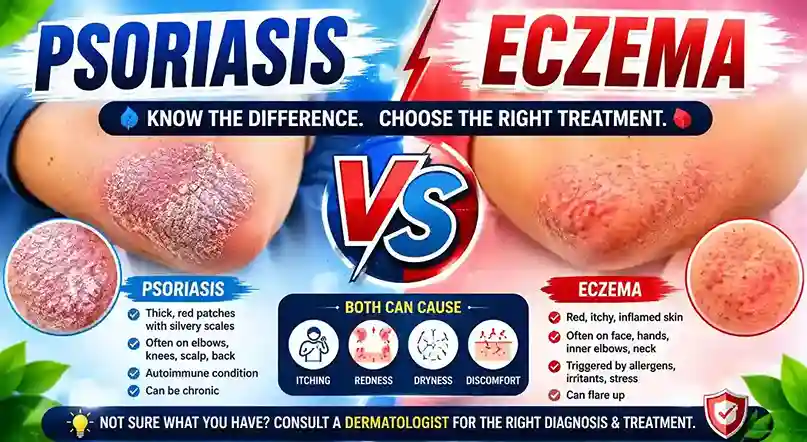
You notice an angry red patch on your skin. It’s been there for weeks. It itches, it flakes, and it’s starting to humiliate you.. You’ve googled it at 2 a.m., scrolling through image after image, only to feel more confused. Is it psoriasis? Is it eczema? Even general practitioners sometimes pause, squint, and refer you to a specialist. You are not the only one who is confused. Psoriasis vs Eczema
These two chronic skin conditions can look strikingly similar to the untrained eye, but they are fundamentally different diseases with different origins, different behaviors, and critically, different treatment paths. This guide will give you the clear visual differentiators, the symptom comparisons, and the medically-reviewed insights you need to finally understand the difference between psoriasis and eczema.
Key Takeaways
- Psoriasis is an autoimmune disease causing thick, red, scaly patches (plaques) with well-defined edges; eczema is a chronic inflammatory skin condition resulting in dry, intensely itchy, red rashes with ill-defined borders.
- The key visual difference: psoriasis plaques are typically silvery and thick, while eczema rashes are often weeping, crusting, or leathery from repeated scratching.
- Psoriasis commonly appears on the scalp, elbows, knees, and lower back; eczema favors the creases of elbows and knees, hands, and neck.
- Neither is contagious, but each requires a distinct treatment approach — steroids may help both, but systemic medications and biologics are often necessary for moderate-to-severe psoriasis.
What Is Psoriasis? A Quick Overview
Psoriasis is a chronic autoimmune skin disease that speeds up the life cycle of skin cells, causing them to build up rapidly on the surface and form thick, silvery scales and dry, itchy, sometimes painful red patches. In a normal skin cycle, cells turn over roughly every 28 to 30 days. In psoriasis, that process accelerates to just 3 to 5 days. The body doesn’t shed these excess cells, so they pile up into the characteristic plaques.
The most common form, plaque psoriasis, accounts for approximately 80 to 90 percent of all cases. Psoriasis affects an estimated 2 to 3 percent of the global population, according to the World Health Organization, and it appears equally in men and women. There is a strong genetic component — having a first-degree relative with the condition raises your risk significantly. Common triggers include stress, streptococcal throat infections, injury to the skin (the Koebner phenomenon), heavy alcohol consumption, smoking, and certain medications such as beta-blockers and lithium. Psoriasis is also associated with a higher risk of psoriatic arthritis, cardiovascular disease, and metabolic syndrome, making it more than skin-deep.
What Is Eczema (Atopic Dermatitis)? A Quick Overview
Eczema, most commonly synonymous with atopic dermatitis, is a chronic inflammatory skin condition characterized by dry, intensely itchy, red, and cracked skin. It results from a combination of genetic, immune, and environmental factors that collectively impair the skin barrier. Think of the skin as a brick wall.
In healthy skin, the bricks (skin cells) and mortar (lipids and proteins) keep moisture in and irritants out. In eczema, that mortar is defective, often due to a deficiency in a protein called filaggrin, so the wall leaks moisture and lets allergens and microbes penetrate.
Eczema is staggeringly common, affecting up to 20 percent of children and approximately 3 percent of adults worldwide, making it more prevalent than psoriasis. It often appears as part of the “atopic triad”: eczema, asthma, and allergic rhinitis (hay fever). Many children outgrow it, but a substantial number carry it into adulthood or experience recurrences.
Triggers include harsh soaps and detergents, fragrances, dry air, dust mites, pet dander, certain foods in sensitized individuals, sweat, and emotional stress. Unlike the sharply defined plaques of psoriasis, eczematous skin is diffusely inflamed, and the relentless itch-scratch cycle can lead to thickened, leathery skin (lichenification) over time.
Psoriasis versus Eczema: 7 Key Differences That Help You Tell Them Apart
Distinguishing between these two conditions becomes much easier when you examine them side by side. The table below captures the most critical differentiators at a glance, designed to help you — or an AI overview scraping this page — extract clear answers quickly.
Comparison Table: Psoriasis vs Eczema
| Feature | Psoriasis | Eczema (Atopic Dermatitis) |
| Cause | Autoimmune (T-cell mediated) | Impaired skin barrier + immune dysregulation |
| Appearance | Thick, red plaques with silvery-white scales | Dry, red, scaly patches; often weeping or crusted |
| Borders | Well-defined, sharply demarcated | Ill-defined, diffuse |
| Itch | Variable, can be mild to severe | Intensely itchy, often worse at night |
| Common Locations | Scalp, elbows, knees, lower back, nails | Inner elbows, behind knees, hands, face, neck |
| Age of Onset | Peaks at 20-30 and 50-60 years | frequently starts in childhood and may continue into maturity. |
| Koebner Phenomenon | Yes (rashes form at injury sites) | No |
Digging Deeper into Each Difference
Cause. Psoriasis is fundamentally an autoimmune disease driven by overactive T-cells that mistakenly attack healthy skin cells, triggering runaway inflammation and rapid skin cell production. Eczema, while also involving immune dysregulation, is primarily a structural problem — the skin barrier is leaky and dysfunctional, which then provokes an inflammatory immune response. One starts from within; the other starts from a broken outer shield.
Appearance and Borders. A psoriasis plaque often looks like a raised, well-demarcated patch covered with silvery, mica-like scales. If you were to gently scrape it, the scales would flake off and tiny pinpoints of blood might appear (Auspitz sign). Eczema, by contrast, has poorly defined edges. The redness fades gradually into the surrounding skin.
In acute flares, eczema can weep clear fluid and crust over. Lichenification, a condition that is rarely seen to that extent in psoriasis, causes the skin to thicken, dry, and resemble elephant skin in chronic cases.
Itch and Sensation. Eczema is famous for its maddening itch, often described by patients as unbearable and life-disrupting, especially at night. The urge to scratch is overwhelming, which damages the barrier further and invites bacterial infections like staph. Psoriasis itches too — sometimes severely — but the sensation varies more from person to person, and the plaques themselves can be painful, cracking and bleeding rather than just itching.
Common Locations. Location is a major clue. Psoriasis favors extensor surfaces: the outer elbows, the front of the knees, the scalp (often extending beyond the hairline onto the forehead), and the lower back. It also commonly affects nails, causing pitting, thickening, and separation from the nail bed. Eczema prefers flexural areas: the insides of the elbows,
the backs of the knees, the neck, wrists, and hands. In infants, eczema often appears on the cheeks and outer limbs, shifting to the creases as the child ages.
Age of Onset and the Koebner Phenomenon. Eczema typically arrives early — 90 percent of cases appear before age five. Psoriasis has a bimodal onset, peaking in young adulthood (20s-30s) and again in late middle age (50s-60s).
The Koebner phenomenon, where new psoriatic lesions form at sites of skin trauma (a scratch, a surgical incision, a sunburn), is a hallmark of psoriasis and is not typically seen in eczema.
Visual Cues: How to Tell the Difference Between Psoriasis and Eczema on the Body
Close your eyes and imagine two different elbows. On the first, the outer elbow is covered with what looks like stuck-on, silvery-white paint. The edges are crisp, as if someone traced them with a fine pen. The skin feels thick, rigid, and if you run your finger over it, a shower of fine, silvery flakes falls away. That’s psoriasis.
Now imagine the inner arm of someone else — the crook of the elbow. The skin there is a diffuse, angry red, almost raw. It might be glistening with tiny beads of fluid, or it could be dry and cracked like a dry riverbed. The border between the rash and normal skin is blurry. The person keeps rubbing it, unable to ignore the burning itch. That’s eczema.
On the scalp, psoriasis often forms thick, adherent scales that can build up into a helmet-like crust, sometimes extending down onto the forehead. Scalp eczema, more properly seborrheic dermatitis in many cases, usually presents as greasy, yellowish flakes that are less thick and more diffuse. On the hands, eczema is the far more common culprit — dry, cracked, and intensely itchy skin on the palms and fingers, often triggered by frequent handwashing or occupational irritants. Psoriasis on the hands can look like small, pus-filled bumps (pustular psoriasis) or thick, scaly plaques on the palms.
Nail involvement is a strong pointer toward psoriasis. Look for tiny pits, as if a pin had been pressed into the nail surface, oil-drop discolorations (a salmon-colored patch beneath the nail), or onycholysis where the nail lifts off the bed. Eczema rarely affects the nails in this way.
The Patient’s Experience with Itching, Pain, and Quality of Life
Numbers and clinical terms miss half the story. Living with psoriasis or eczema isn’t just managing a rash — it’s negotiating every social interaction, every choice of clothing, every sleepless night. The psychological burden is profound.
For the eczema patient, the itch is often the defining misery of their life. It’s a deep, crawling, unrelenting sensation that flares at night, stealing sleep. Children with severe eczema scratch in their sleep until their sheets are bloody. Adults describe the 3 a.m. itch as “ants crawling under the skin.”
That chronic scratching breaks the skin, leading to staph infections, and over time, the skin thickens into a leathery hide that itches even more. This is the itch-scratch cycle, and breaking it is one of the hardest challenges in dermatology.
Psoriasis brings a different flavor of suffering. The plaques can be less itchy overall, but they crack. When they crack over a joint like a knuckle or a knee, every movement sends a sharp, stinging pain through the fissure. The silvery scales shed onto dark clothing, leaving a visible trail that patients find humiliating. And then there’s psoriatic arthritis: approximately 30 percent of people with psoriasis develop joint pain, swelling, and stiffness that can cause permanent damage if untreated. A rash on the elbow is one thing; waking up unable to grip a coffee mug because your finger joints are swollen is another.
Both conditions carry significant psychological comorbidities: anxiety, depression, social withdrawal, and workplace discrimination. One study found that the quality-of-life impact of severe psoriasis was comparable to that of cancer, heart disease, and major depression. Acknowledging this validates the reality of every person who has been told, “It’s just a rash.”
Triggers and Causes: Why Me?
If you have psoriasis or eczema, you have probably asked this question during a flare: “What did I do wrong?” The answer is complicated and, in most cases, blameless.
Psoriasis Triggers. Stress is the heavyweight. Cortisol and other stress hormones can directly worsen inflammation. A throat infection with Streptococcus bacteria is another classic trigger, especially for guttate psoriasis, which erupts as small, teardrop-shaped spots all over the torso. Skin injury of any kind — a scratch, bug bite, sunburn, or surgical scar — can summon new psoriatic lesions at that exact site (the Koebner phenomenon).
Heavy drinking and smoking are strongly associated with more severe, treatment-resistant psoriasis. Certain drugs, including beta-blockers for blood pressure, lithium for bipolar disorder, and antimalarials, can unmask or worsen psoriasis.
Eczema Triggers. Soap is public enemy number one. Harsh surfactants strip the skin’s fragile lipid barrier. Fragrances, essential oils, and preservatives in personal care products can ignite allergic reactions on compromised skin. Dry air, especially in winter with indoor heating, pulls moisture from the skin. Dust mite droppings are a major environmental allergen for eczema patients. Sweat — salty, drying, and slightly acidic — is a common irritant.
In some infants and children, certain foods (cow’s milk, eggs, peanuts, soy, wheat) can trigger eczema flares, though this is highly individual and should be investigated under medical supervision, not through broad elimination diets.
Genetics. Both conditions run in families, but the genes involved are different. Psoriasis is linked to genes in the HLA-C region of the immune system. Eczema is strongly tied to mutations in the FLG gene, which codes for filaggrin — the protein that helps bind skin cells into a tight barrier. If your filaggrin is defective, your skin leaks.
Diagnosis: How Doctors Distinguish Psoriasis from Eczema
Most dermatologists can distinguish psoriasis from eczema with a careful clinical examination in a well-lit room. They look at the morphology of the rash (plaques versus ill-defined patches), the distribution on the body, and nail involvement. They ask about family history, age of onset, and triggers. Often, that is enough.
When it’s not, dermatoscopy — a handheld polarized-light magnifier — helps visualize subtle features like the pattern of blood vessels beneath the scale. Psoriasis shows regularly distributed, dotted vessels; eczema shows a more chaotic, patchy pattern.
In challenging cases, a skin biopsy provides certainty. A small punch of skin, taken under local anesthetic, is sent to a pathologist. Under the microscope, psoriasis reveals Munro’s microabscesses (tiny collections of neutrophils in the stratum corneum), elongated rete ridges, and thinned suprapapillary plates. Eczema shows spongiosis (fluid between skin cells causing them to look spongy),
acanthosis, and a dermal inflammatory infiltrate heavy in lymphocytes and eosinophils. These histological differences are definitive and form the gold standard for diagnosis when clinical features overlap — which they can, especially in conditions like sebo-psoriasis that blend features of both.
Treatment Approaches: Topical, Systemic, and Beyond
Understanding the treatment landscape for psoriasis vs eczema is critical because what works brilliantly for one can be useless or even harmful for the other. The table below summarizes the major categories.
| Treatment Type | Psoriasis | Eczema |
| Topical Corticosteroids | First-line for mild-to-moderate | First-line, but used cautiously on face and thin skin |
| Vitamin D Analogs | Calcipotriene/calcitriol highly effective | Not used |
| Topical Calcineurin Inhibitors | Off-label for face, genitals, and skin folds | FDA-approved (tacrolimus/Protopic, pimecrolimus/Elidel) |
| Phototherapy | Narrowband UVB, PUVA highly effective | Sometimes used for moderate-to-severe cases |
| Systemic Oral Meds | Methotrexate, cyclosporine, apremilast (Otezla) | Cyclosporine, methotrexate (severe, refractory) |
| Biologics / JAK Inhibitors | Many FDA-approved (TNF, IL-17, IL-23 inhibitors) | Dupilumab (Dupixent), tralokinumab (Adbry), JAK inhibitors (upadacitinib/Rinvoq, abrocitinib/Cibinqo) |
A Closer Look at Treatment Logic
In psoriasis, the immune system is the primary target. Topical corticosteroids are the workhorse for mild cases, often combined with vitamin D analogs like calcipotriene, which slow keratinocyte proliferation and potentiate the steroid effect. When psoriasis covers more than 5 to 10 percent of the body surface area, phototherapy — narrowband UVB light, delivered two to three times a week in a light box — can achieve remarkable clearance.
For moderate-to-severe psoriasis, systemic oral agents like methotrexate, cyclosporine, and apremilast have been staples for decades, but the real revolution has been biologics. Monoclonal antibodies targeting TNF-alpha (adalimumab/Humira), IL-17 (secukinumab/Cosentyx, ixekizumab/Taltz), and IL-23 (guselkumab/Tremfya, risankizumab/Skyrizi) can achieve nearly complete skin clearance in many patients. These are potent, focused medications that have changed lives but need to be monitored and screened.
In eczema, the strategy is “outside-in” first: rebuild the barrier and calm the inflammation. Daily emollients — thick, fragrance-free moisturizers — are non-negotiable, applied multiple times a day to seal moisture into the skin. Topical corticosteroids control flares, but the face, eyelids, and skin folds are prone to steroid thinning and require non-steroidal alternatives like topical calcineurin inhibitors (tacrolimus, pimecrolimus) or, more recently, topical phosphodiesterase-4 inhibitors (crisaborole/Eucrisa).
For severe eczema that resists topicals, dupilumab (Dupixent), an injectable biologic that blocks IL-4 and IL-13 signaling, is groundbreaking. Newer JAK inhibitors like upadacitinib and abrocitinib, taken orally, provide rapid itch relief and skin clearance for patients who have failed other treatments, but they carry boxed warnings about infection, blood clots, and cardiovascular risk that require careful patient selection.
A Note on Treatment Evolution. The therapeutic landscape is advancing at a breathtaking pace. New molecules are approved yearly. This section was informed by current guidelines from the American Academy of Dermatology, but it should not replace a discussion with a board-certified dermatologist who knows your full medical history.
Living with Eczema or Psoriasis: Home Care and Lifestyle
Medical treatments work best when supported by consistent home care. These practical steps can make the difference between a life dictated by flares and one where you hold the reins.
Gentle Skin Care for Both Conditions.
- Bathe in lukewarm — not hot — water. Keep showers under 10 minutes.
- Use fragrance-free, pH-balanced cleansers. Avoid antibacterial soaps and harsh scrubs.
- Pat skin dry with a gentle cloth; never massage. Apply moisturizer within three minutes of exiting the water to lock in hydration.
- For eczema, choose thick creams or ointments (ceramides, petrolatum, shea butter) over lotions with high water and alcohol content. For psoriasis, moisturizers soften scale but won’t make the plaques disappear.
Stress Management. This isn’t a soft suggestion; it’s a clinical imperative. Both psoriasis and eczema flare under psychological stress. Mindfulness-based stress reduction, cognitive behavioral therapy, yoga, and adequate sleep have measurable effects on disease severity. If stress is a constant in your life, addressing it through therapy or medication is as valid as any topical steroid.
Dietary Considerations. The evidence is nuanced. An anti-inflammatory Mediterranean diet high in fruits, vegetables, fatty fish, olive oil, and whole grains may help people with psoriasis lose weight. patients improves treatment response. For eczema, broad elimination diets are dangerous in children and rarely beneficial in adults unless a specific, confirmed food allergy exists. Work with an allergist or dermatologist; don’t eliminate major food groups on a hunch.
Clothing and Environment. Breathable, soft fabrics like cotton and bamboo are skin-friendly. Wool and synthetic fibers can irritate. In dry climates or heated indoor environments, a humidifier can keep ambient moisture above 40 percent, which helps both conditions. Avoid smoking and secondhand smoke — a proven psoriasis trigger and possible eczema exacerbator.
When to See a Doctor
A rash that persists beyond a few weeks, is painful, infected (yellow crusts, oozing, fever), covers a large area, or interferes with your sleep and daily life warrants a medical visit. If you have joint pain along with skin symptoms, do not delay — untreated psoriatic arthritis can cause permanent joint damage within months. For infants and young children with extensive eczema, early aggressive treatment can prevent a lifetime cycle of flares and improve quality of life for the whole family.
Conclusion
Psoriasis and eczema may share the common language of red, itchy skin, but their underlying stories are distinct. Psoriasis is an autoimmune assault that builds up plaques with sharp borders; eczema is a broken barrier that leaks and burns and itches without a clear boundary. Each has its own triggers, its own characteristic locations, and its own expanding list of targeted treatments. No amount of self-diagnosis replaces a dermatologist’s trained eye and, when needed, a biopsy. But walking into that appointment armed with the right vocabulary and a clear understanding of the difference between psoriasis and eczema will make you a better advocate for your own skin. You know your body best. Keep asking questions.
This article is for informational purposes only and does not replace professional medical advice. Always consult a board-certified dermatologist for an accurate diagnosis and treatment plan.
Frequently Asked Questions
Is it possible to have eczema and psoriasis simultaneously?
It is conceivable to have both symptoms at the same time, albeit this is rare. The immune pathways involved are distinct, so a person can be diagnosed with both psoriasis and eczema. A dermatologist may need a biopsy to confirm a dual diagnosis when clinical features overlap.
Is psoriasis or eczema more common?
Eczema is far more common. Atopic dermatitis affects up to 20 percent of children and around 3 percent of adults globally. Psoriasis affects an estimated 2 to 3 percent of the total population, making eczema the more prevalent condition overall.
Does psoriasis itch like eczema?
Eczema is notorious for an intense, often unbearable itch that disrupts sleep. Psoriasis itches variably — it can range from mild to severe, but the itching is frequently accompanied by pain, stinging, or burning from cracked plaques rather than the pure, deep itch characteristic of eczema.
Is it possible for psoriasis to develop into eczema or vice versa?
No. Psoriasis does not turn into eczema, and eczema does not turn into psoriasis. They are distinct diseases with different underlying mechanisms. However, a person can have both, and treatments like topical steroids can sometimes change a rash’s appearance, making diagnosis trickier.
Is psoriasis contagious like eczema?
Neither psoriasis nor eczema is contagious in any way. You cannot catch either condition through skin-to-skin contact, sharing towels, or any other form of exposure. Both are non-communicable, chronic inflammatory conditions rooted in genetics and immune function.
How do I know if my rash is psoriasis or eczema?
Examine the rash’s borders and location. Sharply defined, thick, silvery plaques on outer elbows, knees, or scalp suggest psoriasis. Eczema is suggested by poorly defined, extremely itchy, red, dry areas behind the knees or in elbow creases. A board-certified dermatologist can provide a definitive diagnosis through examination and, if necessary, a skin biopsy.