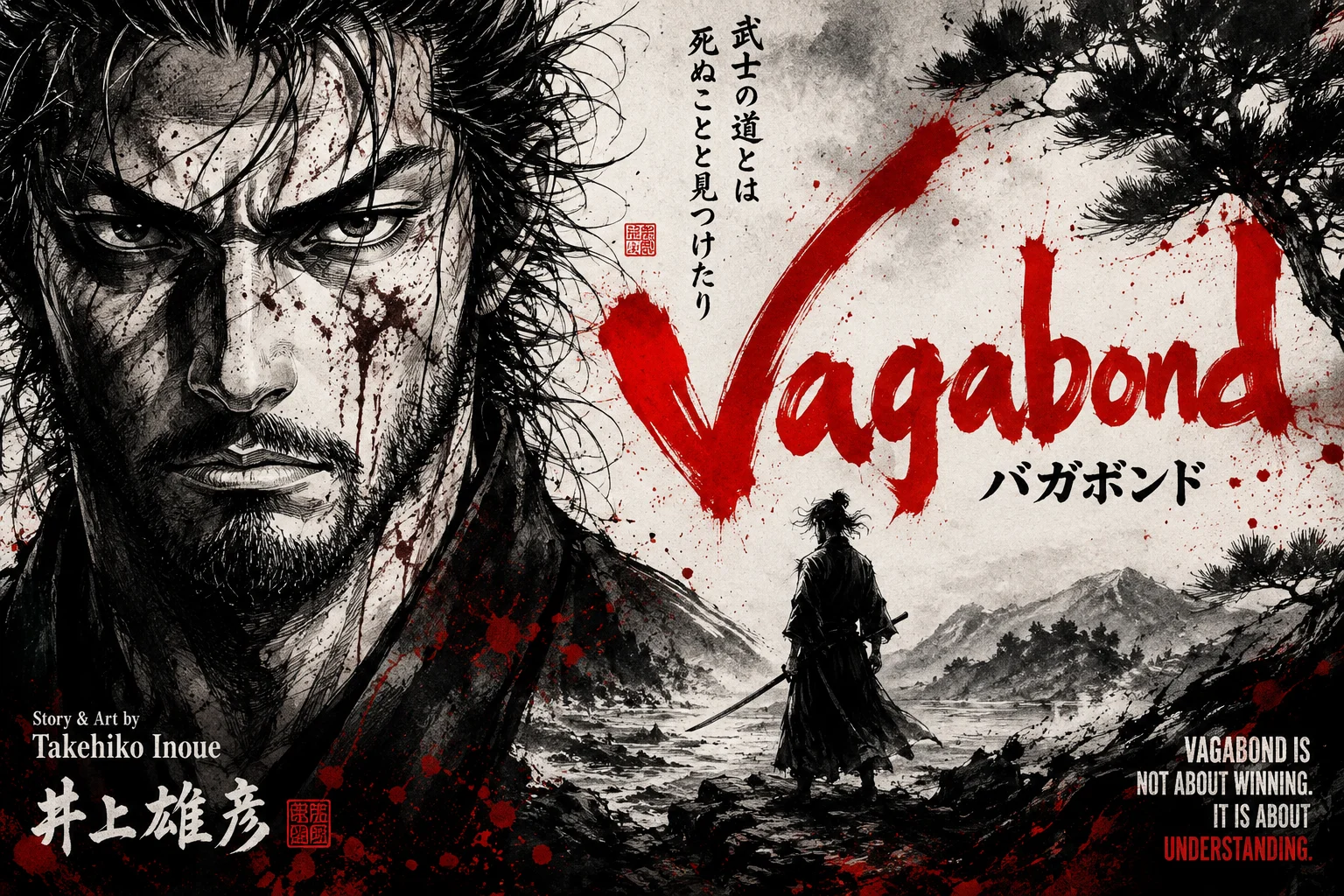
Vagabond Manga: The Complete Guide to Takehiko Inoue’s Samurai Epic
Samurai stories have existed in Japanese storytelling for centuries, but few have captured the raw, human side of a warrior’s life the way Vagabond does. Published since 1998 and illustrated with a level of artistry rarely seen in comics, this series has earned a permanent place among the greatest manga ever created — not through hype, but through genuine depth.
Whether you are picking it up for the first time or returning after years away, this guide covers everything worth knowing.
What Is the Vagabond Manga?
Vagabond is a historical seinen manga that chronicles the fictionalized life of Miyamoto Musashi, Japan’s most celebrated swordsman. The story opens in the chaotic aftermath of the Battle of Sekigahara, where a brash young man named Shinmen Takezo barely escapes with his life. Haunted by violence and desperate to prove himself, he sets out on a years-long journey across feudal Japan — not just to master the sword, but to understand what it means to truly live.
The narrative pulls from Musashi, the classic novel by Eiji Yoshikawa, while Inoue reshapes it into something deeply personal and visually transformative. At its core, the manga asks a question that resonates beyond its historical setting: What does it actually mean to be strong?
Who Is Takehiko Inoue?
Takehiko Inoue built his reputation with Slam Dunk, a beloved basketball manga that remains one of the best-selling series in manga history. When he pivoted to a completely different genre with Vagabond, many wondered whether the transition would hold. It did — and then some.
Inoue approaches each page with the patience of a painter. His use of sumi-e ink brush techniques, borrowed from traditional Japanese art, gives the series a texture and weight that most comics never achieve. His commitment to anatomical precision, emotional expression, and landscape detail earned him the Kodansha Manga Award in 2000, just two years into the series.
For readers who want to understand why Vagabond feels so different, the answer begins with its creator.
The Artwork: A New Standard for Manga Illustration
Few manga series have pushed the visual boundaries of the medium the way Vagabond does. Inoue draws in a style that blends intense realism with expressive, almost impressionistic energy. Battle scenes feel more like controlled mayhem caught in mid-breath than they are rehearsed.
What stands out most is how Inoue uses negative space and natural scenery. Rain, bamboo groves, still water, and open sky become active storytelling elements rather than passive backdrops. A single splash page of a misty mountain path communicates more about Musashi’s internal state than pages of dialogue ever could.
This approach has made Vagabond a reference point for aspiring comic artists worldwide, not just in Japan. Its influence on anatomical drawing, brush technique, and page composition is still visible in new manga releases decades later.
Main Characters and Why They Matter
The cast of Vagabond is built around contrast. Each character reflects a different answer to the question the story keeps asking about strength, meaning, and purpose.
Miyamoto Musashi begins the story driven entirely by ego and fear disguised as ambition. His evolution — from a violent, desperate young man into someone grappling with genuine wisdom — forms the emotional backbone of the entire series.
Sasaki Kojiro is arguably the most remarkable character in the manga. Born deaf and unable to speak, he understands swordsmanship not through instruction but through pure instinct and joy. He represents a form of mastery entirely different from Musashi’s, which makes their eventual confrontation one of the most anticipated moments in manga history.
Takuan Soho, the eccentric monk, serves as a philosophical counterweight. He sees through Musashi’s arrogance early on and plants ideas that take years for Musashi to fully absorb.
Matahachi, Musashi’s childhood friend, takes the opposite path — shaped by weakness, poor choices, and self-deception. His story is painful precisely because it feels true.
Otsu anchors the human, emotional side of the story — a reminder of the ordinary life Musashi keeps moving away from.
The Historical Setting: Edo Period Japan
Vagabond is set in the early 17th century, during the transition into the Edo period — a time when Japan was still healing from decades of civil war. Samurai culture was shifting, the old codes of bushido were being tested, and wandering swordsmen occupied an uncertain place in society.
Inoue renders this world with impressive authenticity: the architecture, clothing, farming communities, regional politics, and the economics of life for people outside the upper classes. Readers absorb this historical texture naturally, without ever feeling like they are reading a textbook.
No prior knowledge of Japanese history is needed to follow the story. The context builds itself page by page.
Core Themes: Beyond the Sword
Because of what lies underneath the surface of its sword fights, Vagabond truly earns its reputation as a literary manga.
The nature of strength is the central question. Musashi begins by defining strength as the ability to defeat opponents. As the story progresses, that definition keeps breaking down. True strength, the manga suggests, may have nothing to do with dominance.
Acceptance of mortality runs through nearly every arc. Characters who fight with no fear of death often do so more cleanly and honestly than those consumed by the desire to survive at any cost.
The weight of ego shapes every confrontation Musashi has — both with other swordsmen and with himself. Inoue is particularly good at showing how pride and insecurity look identical from the outside.
Solitude and connection form a quiet tension throughout. Musashi’s path keeps pulling him away from people he cares about, yet his growth depends entirely on what those people teach him.
How Vagabond Compares to Other Samurai Manga
The samurai manga genre includes celebrated titles like Rurouni Kenshin, Blade of the Immortal, and Lone Wolf and Cub. Each has genuine strengths, but Vagabond occupies a different space.
Where Rurouni Kenshin leans into action and redemption arcs with a lighter tone, Vagabond is slower, heavier, and more psychologically demanding. Where Blade of the Immortal uses supernatural mechanics to drive its plot, Vagabond stays grounded in physical and emotional reality.
The closest comparison might be literary historical fiction in novel form — something closer to Cormac McCarthy’s treatment of violence and landscape than to most action comics. That is not a criticism of the genre. It simply explains why Vagabond appeals to readers who do not typically read manga.
Why Is Vagabond on Hiatus?
The series entered an extended hiatus around 2015 after Chapter 327, and as of 2025, no new chapters have been released on a regular schedule.
Inoue has spoken publicly about the difficulty of finding the right ending for a story this emotionally complex. He has also acknowledged the physical toll that his detailed brushwork demands. The hiatus is not a cancellation — Inoue has confirmed the series is not abandoned — but there is no confirmed return date.
During this period, Inoue has worked on other projects, including Real, his wheelchair basketball manga, and occasional gallery art. Short special chapters related to Vagabond have appeared at intervals, which most fans interpret as a sign that the story has not been set aside permanently.
The wait is frustrating. The uncertainty is also part of what makes the existing 37 volumes feel more precious.
Where to Read Vagabond Officially
Supporting the official release matters both ethically and practically. Official editions offer the best print quality, accurate translations, and ensure that the creator benefits from reader support.
- Physical volumes are available through major book retailers. Viz Media publishes the English edition.
- Digital editions are available on platforms including Amazon Kindle and the Viz Media website.
- Original Japanese volumes are published by Kodansha under their Weekly Morning imprint.
The vizbig editions, which collect three volumes in a larger format, are particularly popular for showcasing Inoue’s artwork at a scale that does it justice.
Vagabond Manga: Key Details at a Glance
| Feature | Details |
| Title | Vagabond |
| Creator | Takehiko Inoue |
| Genre | Seinen / Historical / Action / Drama |
| Original Publisher | Kodansha (Weekly Morning) |
| English Publisher | Viz Media |
| Total Volumes | 37 (Ongoing Hiatus) |
| Protagonist | Miyamoto Musashi |
| Source Material | Musashi by Eiji Yoshikawa |
| Art Style | Realistic with sumi-e ink brush influences |
| Major Award | Kodansha Manga Award (2000) |
How Vagabond Changed Seinen Manga
Before Vagabond, the idea that manga could function as serious literary art was present but not fully proven to mainstream audiences. Inoue made the argument visually and commercially. The series sold over 80 million copies and demonstrated that adult readers would invest in slow, psychologically dense storytelling if the craft was exceptional.
It shifted expectations for what fight scenes could accomplish narratively. It proved that historical settings could carry as much weight as fantasy or science fiction. And it gave subsequent generations of manga artists a benchmark for anatomical illustration and brushwork that is still studied in art schools today.
Frequently Asked Questions
Is the Vagabond manga finished?
No. The series has been on hiatus since approximately 2015 and covers 37 volumes. Takehiko Inoue has not officially ended the series, though no active publication schedule exists.
How many volumes does Vagabond have?
There are 37 collected volumes. The story covers a substantial portion of Musashi’s life but does not yet include its conclusion.
Do I need background knowledge of Japanese history to enjoy it?
Not at all. Inoue builds the historical context into the story naturally. Readers unfamiliar with the Edo period will absorb the setting as they read without needing external research.
Is Vagabond appropriate for younger readers?
It is a seinen title aimed at adult audiences. The series contains graphic violence, mature psychological content, and thematic weight that suits older teenagers and adults more than younger readers.
Will there ever be a Vagabond anime?
No anime adaptation has been confirmed. Inoue has historically been cautious about adapting the series, and many in the community believe the intricacy of the brushwork would be exceptionally difficult to translate into animation faithfully.
How does Vagabond compare to Slam Dunk?
Both are exceptional, but Vagabond represents a more mature and artistically ambitious phase of Inoue’s career. Slam Dunk is joyful, kinetic, and accessible. Vagabond is contemplative, weighty, and visually complex. They showcase different strengths from the same extraordinary creator.
Final Thoughts
Vagabond is the kind of manga that changes what you expect from the medium. It earns every comparison to high literature, not because it tries to be literary, but because Inoue cared deeply about his craft and his character — both Musashi’s character on the page and his own artistic integrity in making it.
If you have not started it yet, Volume 1 is the right place to begin. If you read it years ago and stepped away, it holds up. The 37 volumes that exist are already one of the great achievements in sequential art, hiatus or not.